
Two Weeks Before Capitol College
A last-minute audition sent Dion Wilson to SUNY Purchase in 1996. Thirty years and a Spanish Bitcoin book later, the circle he did not know he was drawing has closed.* Weeks Before Capitol College

In August of 1996, Dion Wilson had already met his college roommate. His freshman year at Capitol College, a small, technically-focused school in Laurel, Maryland, twenty minutes from Washington, was two weeks away. He was seventeen years old. He was going to be a computer science major. He had just graduated from the Baltimore School for the Arts.
He had also, quietly, almost given up on dance.
Capitol College in 1996 was a small institution with an outsized specialty. Founded in 1927 by a former U.S. Navy Radioman as the Capitol Radio Engineering Institute, it had, by the mid-1990s, become one of the few private colleges in the country that trained undergraduates almost exclusively in engineering, computer science, and information technology. Its six residence halls were named after inventors: Bell, De Forest, Edison, Franklin, Morse, and Steinmetz. This was where a serious young person with a scientific mind went to become a serious young engineer with a scientific career. In 1996, if you told a smart Baltimore kid that his future was in networks and data and eventually something called the internet, this is a school he might have chosen.
Dion had chosen it. Then, at the last minute, his dance director at the Baltimore School for the Arts asked him to audition for one more program.
It was SUNY Purchase. The BFA in Dance at Purchase College is, and was even then, one of the most demanding conservatory-style dance programs in the United States. The audition was preposterously late in the cycle. The school year was starting in two weeks. He went anyway. He danced for a panel who had never seen him. They accepted him that same day.
Two weeks later, the boy who was supposed to be studying computer science in a dorm named after Alexander Graham Bell was a freshman conservatory dancer at SUNY Purchase.
Thirty years later, he still remembers the way that audition felt.
What followed was a career.
In 1998, before he had even finished his BFA, he joined the Philadelphia Dance Company. In 2000, he joined Dance Theatre of Harlem. In 2001 he completed his BFA in Dance Performance at Purchase and joined the Alvin Ailey American Dance Theater. He performed with Asheville Civic Ballet and the Jones-Haywood School of Ballet. He worked with Debbie Allen on Pepito’s Story. He held the Princess Grace Foundation Fellowship for dance in 1999 and the Maryland State Arts Council Award for Solo Dance Performance in 2000. He later toured the country with Disney’s The Lion King. He spent a working lifetime inside the room that Purchase let him walk into two weeks before it should have been impossible.
And then he stopped dancing.
The founding of Bitcoin For The Arts, Inc., in 2024, was not framed as a return to the road not taken. It was framed as the natural next step of a working artist who had spent his life understanding what it costs to make art inside a broken monetary system, who had encountered Bitcoin, and who had realized that no one else was building the bridge he wanted to walk across.
But the shape of the bridge is worth looking at.
Bitcoin For The Arts is a technology-native nonprofit. Its grantmaking runs on Bitcoin. Its podcast, Share Your Bitcoin Journey, is Podcasting 2.0 compliant with Value-4-Value Lightning splits that route sats to artists in real time. Its Artist Directory is a database on the open web. Its Nostr presence is native. Its Substack is native. Its Geyser page is native. Everything about the way BFTA operates is built on top of technology that would have been unrecognizable to a seventeen-year-old in a Baltimore dorm room in 1996, for the simple reason that Bitcoin did not exist yet. The white paper was not published until 2008. The Genesis Block was not mined until January 3, 2009. The tools that BFTA uses every day are, on the scale of a human career, brand new.
Which is to say: even if Dion had stayed the course in 1996, gone to Capitol College, graduated in 2000 with a computer science degree, and become an engineer, he would not have been able to found Bitcoin For The Arts in the year 2000 or 2005 or 2008. The technology to bridge Bitcoin and the arts did not exist in 1996 and would not exist for the next thirteen years. The road not taken did not go anywhere Bitcoin For The Arts is standing today, because that road did not exist yet.
The road that did was the stage.
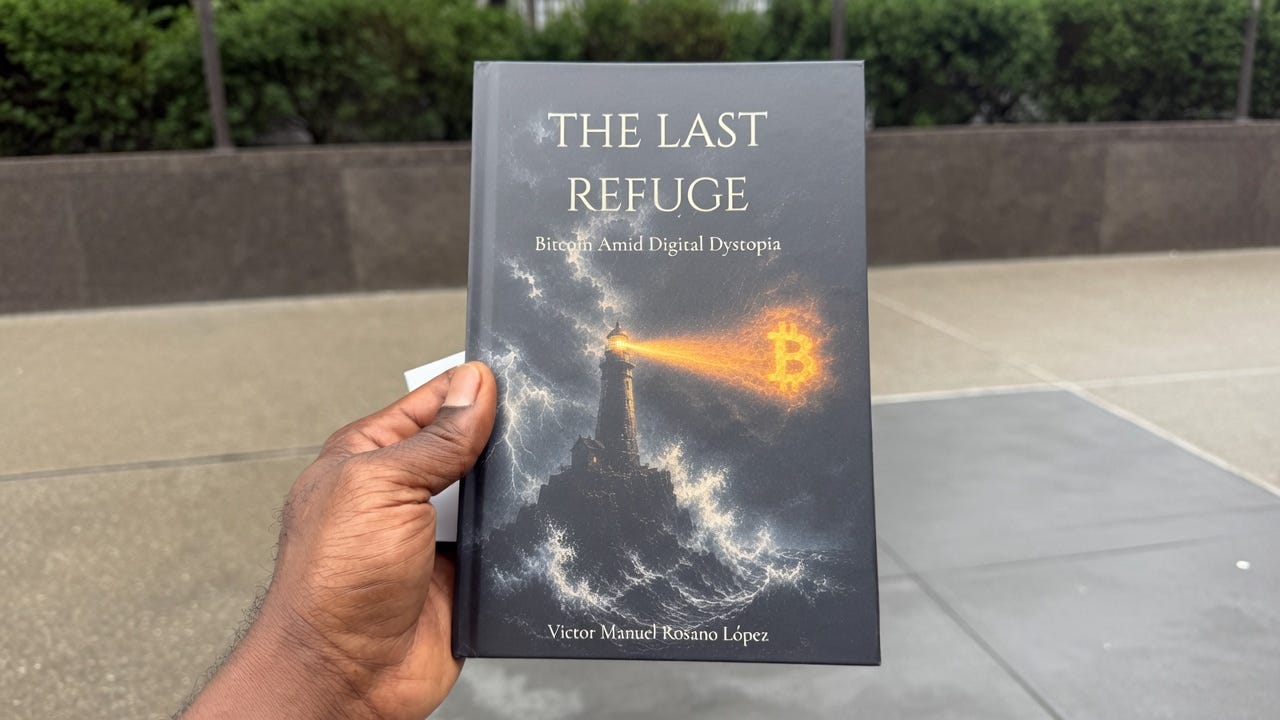
This week, a hardcover book with a lighthouse on the cover arrived at Dion’s door. The sender was Victor Manuel Rosano López himself.
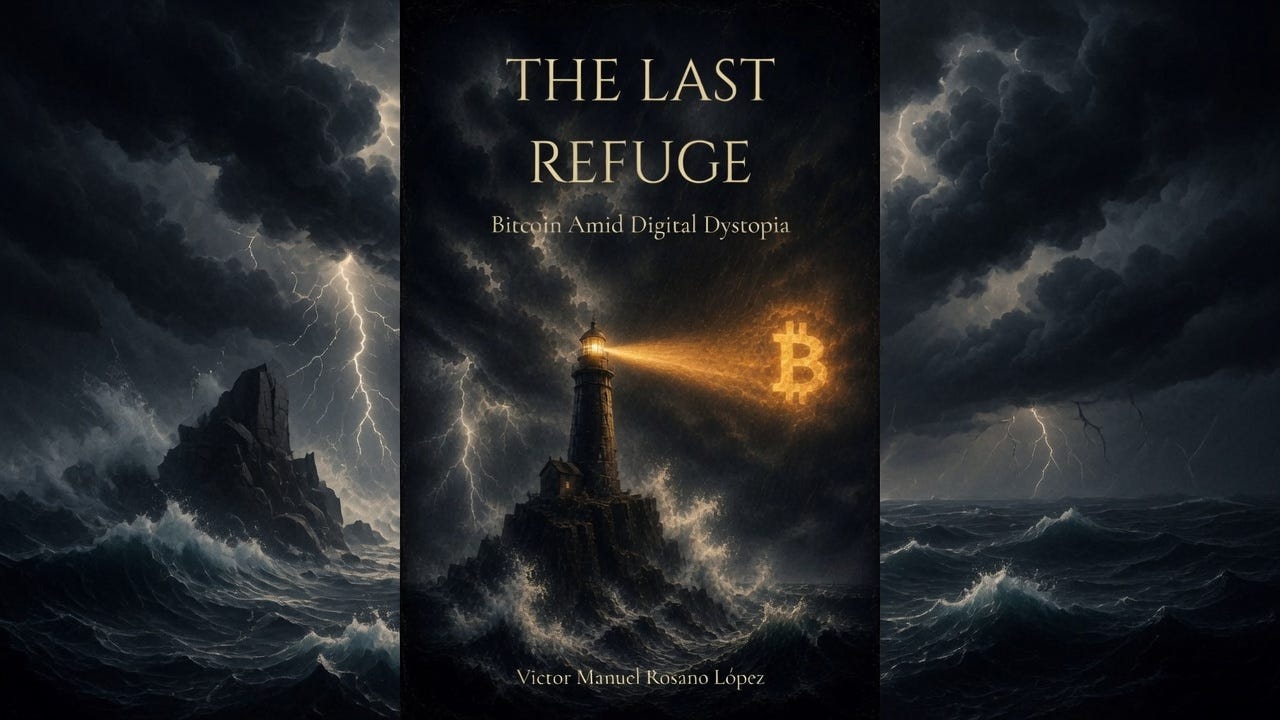
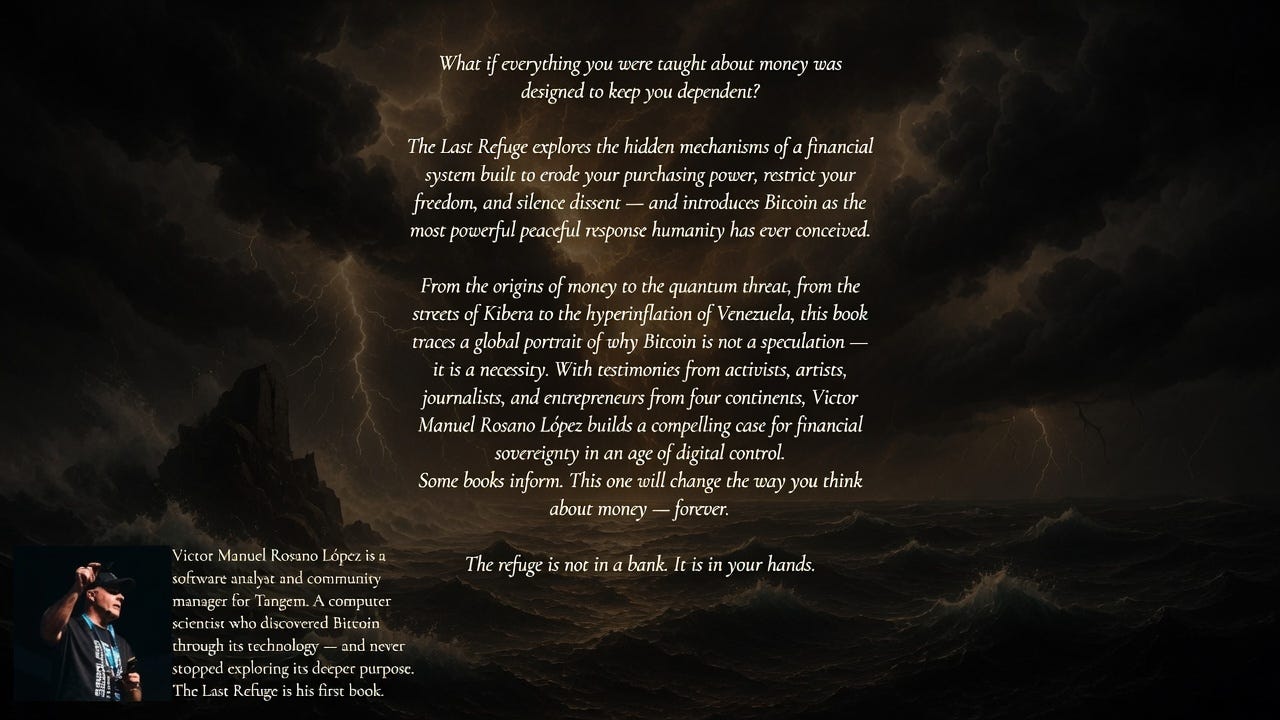
The title is The Last Refuge: Bitcoin Amid Digital Dystopia. Rosano López is a Spanish computer scientist and software analyst from Jerez de la Frontera in Andalusia, currently a community manager at Tangem. The book is his first. In his own words, he first encountered Bitcoin through its technology and then “never stopped exploring its deeper purpose.” The Last Refuge is a survey of Bitcoin as a peaceful instrument for reclaiming autonomy, sovereignty, and freedom from centralized digital control. It draws testimonies from activists, artists, journalists, and entrepreneurs across four continents. Every Lightning purchase of the book on Leanpub routes entirely to three nonprofits: Bitcoin Transformation Community, Women of Bitcoin, and Bitcoin For The Arts.
Dion opened the table of contents and looked down at Chapter 14. It is called “Bitcoin Is Hope.” Two interviews are listed under the chapter title. The first is with Justin Rhedrick. The second is with Dion Wilson.
He is quoted, in a chapter titled “Bitcoin Is Hope,” inside a book about Bitcoin as the last refuge for human sovereignty, alongside the Puerto Rican filmmaker behind Dirty Coin, alongside the French Bitcoin veteran Alexandre Laizet, alongside the Kenyan and Salvadorian and Venezuelan Bitcoiners who are building sound money from below.
The book was written by a Spanish computer scientist. Dion Wilson, thirty years earlier, was two weeks away from becoming one.
Two men on opposite ends of the same road.
Rosano López, from Spain, arrived at Bitcoin from the technology end. He was drawn to the cryptography, the architecture, the decentralized design, and then, slowly, to the deeper purpose that the technology was pointing at. Dion Wilson, from Baltimore, arrived at Bitcoin from the stage end. He spent a life inside the arts, watched what fiat inflation did to working artists, and then, slowly, arrived at the technology that could give them a different set of rails. Both of them met inside a single chapter about hope. Neither of them could have plotted this in advance. It is a story neither of them would have made up if they tried.
Bitcoin For The Arts has always argued that the artists who understand Bitcoin will be the people who bring the rest of the artistic world across the bridge. Dion has said it a hundred times on Share Your Bitcoin Journey. He has said it in every newsletter. He has said it at every conference. But this week, holding a book he did not expect, he was on the other side of the argument. He was the artist someone had already brought across. Someone had built the bridge for him. Someone had put him in a book. He is what the story is about now.
The book landing at his door is the kind of moment that could only happen inside this movement.
Victor did not owe him this. There was no invoice, no contract, no algorithmic incentive routing a gift from Andalusia to a nonprofit founder in the United States. One Bitcoiner mailed a book to another Bitcoiner because he thought it belonged in his hands. The broken fiat system does not produce moments like this. It cannot. Its whole architecture rewards extraction and volume, not care and craft and slow honest exchange. Sound money produces this exact moment, over and over, at every scale, because it is built for a longer time horizon and a smaller trust radius and a kinder economy of gratitude. Dion has said, more than once, that the reason he can build Bitcoin For The Arts with confidence is that he is inside a community of morally serious people who behave this way as a matter of course. Victor is one of them. There are many more.
The rest of the arts world does not know this yet. Getting them to know it is the work.
Dion has not yet decided what he is going to do next. But he is not going to imagine it.
He has learned, twice now, that the road he is on turns in ways he cannot predict from where he is standing. In 1996, he could not have imagined a career at Alvin Ailey. In 2001, he could not have imagined touring in The Lion King. In 2024, he could not have imagined a Spanish computer scientist writing his name into a book about digital sovereignty. It has been, as he has said, a remarkable ride so far.
If it is remarkable, it is because he keeps walking.
Bitcoin For The Arts is the second act of an artist who was two weeks away from becoming an engineer in 1996 and did not become one, and who instead became a dancer, and then a nonprofit founder, and then, without quite noticing when it happened, both an artist and an engineer at the same time.
Whatever the next chapter is called, this one is not the ending.
Bitcoin For The Arts, Inc. is a 501(c)(3) nonprofit funding working artists with Bitcoin micro-grants, education, and sovereign funding tools. You can find us at bitcoinforthearts.org and on Substack. Share Your Bitcoin Journey is available on Apple Podcasts, Spotify, and YouTube.
Buy The Last Refuge: Bitcoin Amid Digital Dystopia by Victor Manuel Rosano López on Leanpub. Every Lightning purchase routes entirely to Bitcoin For The Arts, Bitcoin Transformation Community, and Women of Bitcoin. Connect with Victor on LinkedIn.