The ARPA Cliff
Federal pandemic money quietly propped up American city arts budgets for four years. It runs out in months. Boston is what happens next.

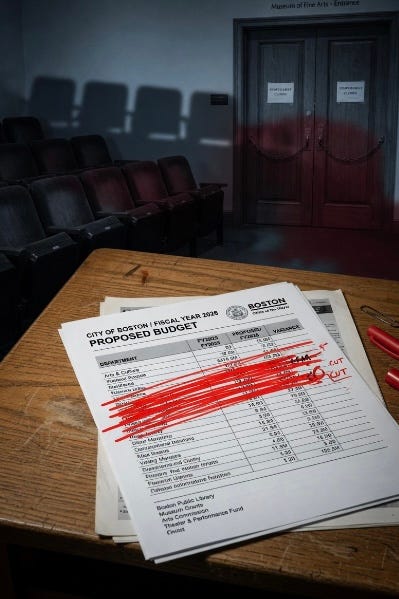
On April 8, 2026, Mayor Michelle Wu of Boston filed a proposed FY2027 budget that included a 27% cut to the Mayor’s Office of Arts and Culture. The cut leaves the city’s arts budget at roughly $3.4 million — about 0.07% of Boston’s total $4.9 billion budget. By the standards of municipal cuts, it is small in absolute terms. By the standards of the arts community trying to survive it, it is large enough to end programs.
But the 27% cut is not the actual story.
The actual story is what Kim Córdova surfaced in her April 25 reporting for Boston Art Review: the cut is happening at the same time as the expiration of federal American Rescue Plan Act funding, which had quietly been propping up Boston’s arts spending for the last four years. Boston received $26.2 million in federal ARPA dollars earmarked for arts and culture starting in 2021. That money built or expanded a series of programs — equity-focused grants for BIPOC-led organizations, the Boston Family Days program offering K-12 students free access to museums, the SPACE Grant for filling vacant commercial real estate with arts uses — that the city celebrated as evidence of progress.
That money was always temporary. It expires at the end of 2026.
When it does, the underlying truth gets exposed. According to a 2016 study by the Boston Foundation comparing per-capita government arts support across major American cities, Boston ranked dead last among the ten cities studied — including peers with significantly smaller arts ecosystems. The implication is unkind: Boston has, for decades, underinvested in its own cultural infrastructure relative to comparable cities, and ARPA was the federal cash infusion that briefly disguised the gap.
Now ARPA is winding down. Wu’s proposed cuts come on top of that. Combined, they reveal an underinvestment problem that was always there and is now no longer paperable over.
This is not a Boston story. This is a national story, playing out in dozens of American cities right now, and BFTA is writing it because almost no one else is yet.
What the Cliff Actually Looks Like
The American Rescue Plan Act, signed into law in March 2021, distributed roughly $350 billion to state and local governments under what was called the Coronavirus State and Local Fiscal Recovery Fund. Cities used those dollars to fill pandemic-era revenue gaps and, in many cases, to fund initiatives that had been politically aspirational for years but had never been affordable in normal budget cycles.
ARPA money was supposed to be obligated by the end of 2024 and spent by the end of 2026. Cities all over the country complied, often by spinning up multi-year programs that ran on the federal stimulus and gave the appearance of permanent expansion. Detroit, Pittsburgh, Atlanta, Philadelphia, Newark, Cleveland, Memphis, Oakland, Birmingham, and dozens of mid-sized cities used a portion of their ARPA allocations to fund arts and culture programming on a scale that prior local budgets had never supported.
We are months away from finding out what happens when the music stops.
Some of those programs will quietly disappear. Some will be partially absorbed into general funds, dramatically scaled back, or restructured as public-private partnerships that depend on philanthropic capital that no longer exists at the same scale. Some cities will tell their arts communities that the cuts are temporary, the result of a one-time shock, and that things will return to normal once economic conditions improve.
The arts communities will know, by the second or third year, that they have not.
The reason ARPA arts spending is not coming back is not primarily political. It is structural. The federal stimulus was a one-time infusion of money created out of an emergency that nobody wants to repeat. The next emergency, when it comes, will not necessarily produce the same arts-friendly response. And the underlying fiscal capacity of American cities — the actual property-tax-and-sales-tax base that funds non-emergency operating budgets — has not gotten healthier since 2021.
It has gotten worse.
Why Cities Cannot Replace the Cliff
To understand why Boston cannot simply replace the ARPA money with general-fund spending, look at the revenue side of the city’s books.
According to the Boston Municipal Research Bureau, 73.1% of Boston’s FY2027 revenue comes from property taxes. Net property tax growth is projected to be the lowest in nearly thirty years. The reason is plain: the commercial real estate market that produces a significant share of Boston’s property tax base has been crushed by the post-pandemic shift to remote work, with downtown office buildings sitting at vacancy rates that, in some cases, are the worst in modern recorded history.
Cities like Boston are revenue-concentrated in exactly the wrong asset class for this decade. When commercial real estate goes down, so does the funding base for everything the city does — schools, public safety, sanitation, and yes, arts.
On the spending side, Boston’s costs are climbing. The expiration of Affordable Care Act subsidies at the end of 2025 caused city employee health insurance costs to rise 23.9% in a single year. Health insurance now consumes 9.7% of Boston’s entire budget. Pension obligations, state assessments, and debt service together account for roughly a quarter of the budget and are legally non-discretionary. Public schools and public safety together account for over half. The city’s flexibility is, by the time you reach arts and culture in the spending priority list, almost zero.
This is not a Boston problem. This is a structural feature of how American cities fund themselves: brittle revenue (concentrated in a single asset class that cycles violently), inflexible expenses (locked in by collective bargaining agreements, pension obligations, and federal mandates), and discretionary categories (arts, parks, libraries, community programs) that always get cut first because they are the only line items the mayor actually has the legal authority to cut.
Every American city is on a version of this curve. The ARPA money disguised it for four years. We are now in the year that disguise comes off.
Who Gets Hit First
Boston Art Review’s reporting included an emailed statement from Karthik Subramanian of Company One Theatre, which is worth quoting in full because it identifies precisely who absorbs the cliff:
“Combined with reductions from the National Endowment for the Arts and decreased individual and philanthropic giving, Boston’s arts and cultural community feels increasing strain. These pressures are likely to be felt most acutely by small, BIPOC-led organizations, often operating with fewer financial buffers. In a city that has made meaningful progress in supporting these groups, the timing of these budget cuts presents a significant added challenge.”
Subramanian is naming something important and uncomfortable. The cuts will not hit evenly. The ARPA programs that disappear first will be the ones built specifically to address the equity gaps that previous Boston budgets had ignored — the small BIPOC-led organizations, the community arts spaces in neighborhoods the cabinet-level Office of Arts and Culture only began funding intentionally during the ARPA window. Those organizations have the smallest reserves, the thinnest fundraising teams, and the least access to the philanthropic networks that backstop more established institutions.
The cliff is not a flat plateau where everybody falls together. It is a slope, and the people standing at the bottom are the ones who got there last.
This pattern will repeat in every city where ARPA money was directed at organizations that had previously been neglected. Cities used the federal stimulus to do the equity work that had been deferred for decades. When the stimulus ends, the equity work goes first. Not because anybody chose for it to. Because the structural funding base never actually expanded — the federal government just temporarily pretended it had.
What was true in Boston in 2016 — that government arts support was lower per capita than in any peer city — was masked for four years by federal pandemic money. After this year, it is going to be true again, and the organizations that exist because of the masking are the ones who absorb the unmasking.
This is not a problem any single city can fix on its own. The ARPA money came from outside the city’s fiscal capacity, and now it is leaving from outside the city’s fiscal capacity. Boston is not unique in this. We are watching a national de-funding that happens to be playing out one city at a time.
What Bitcoin Has To Do With This
Bitcoin for the Arts is a 501(c)(3) nonprofit (EIN 41-2642260) building a different kind of arts funding instrument — one that fails differently than the ones above. We are not pretending we can replace federal stimulus or municipal arts budgets. The numbers do not work, and the ambition would be ridiculous. What we are arguing is that the funding mechanism itself is the real story, and that any community serious about durable arts funding needs to add at least one instrument that does not depend on the same set of fragilities.
The fragilities, listed plainly:
Federal stimulus is one-shot. Money created in response to an emergency is not sustained funding. It cannot be planned around. Anyone who built a multi-year program on ARPA dollars is now learning this.
Municipal property tax is asset-class-concentrated. When commercial real estate craters, every program funded from that revenue base shrinks together. Arts go first because they have no constituency that can bargain back.
State arts agencies follow the same logic. State legislative appropriations for arts agencies are projected to drop 7.7% nationally in FY2026. Twenty-one states are projecting decreases. The same fragilities apply, just at a different level of government.
Foundations are not insulated. Endowments invested in equities and bonds are subject to inflation, market corrections, and reallocation by trustees who answer to boards with their own institutional pressures.
Even ticket revenue is fragile. Local discretionary spending depends on consumer confidence, which depends on the broader economy, which depends on a monetary system that has been printing money to paper over fiscal gaps for fifteen years.
What none of these have in common with each other is independence from the dollar. Every single instrument above is denominated in a currency designed to lose purchasing power over time. Even when one of them appreciates in nominal terms, the dollars it holds buy less art each year. Inflation is the slow tax that the arts pay simply for existing.
A Bitcoin reserve is the only mainstream financial instrument we know of that is structurally designed to appreciate in purchasing power against the dollar over multi-decade time horizons. Its supply is fixed at 21 million coins, by mathematical rule, forever. As demand for that fixed supply grows — as it has, demonstrably, since Bitcoin’s invention in 2009 — the purchasing power of a Bitcoin reserve grows with it.
This is, narrowly, what Bitcoin solves: the slow erosion problem. It does not solve cancel-by-email, although it incidentally does. It does not solve the property tax base, although it adds an alternative. It does not save anyone from a hostile administration or a bad mayor or an arts cabinet that gets eliminated. What it does is hold value across decades in a way that the dollar provably does not.
If your nonprofit’s reserve sits in dollars, it shrinks against everything that matters every year. If your nonprofit’s reserve sits in Bitcoin, it grows. Over a thirty-year endowment horizon, that difference is not academic.
That is the case for Bitcoin in arts funding, narrowly stated.
What We Are Building, Specifically
We are paying working artists directly in Bitcoin, in micro-grants ranging from $500 to $2,000 in our current funding round. The grants are settled to the artist’s wallet within hours of approval, paid in BTC, with no possibility of revocation by any board, agency, or administration.
Every donation we receive flows through a public allocation rule we call 55/30/10/5:
55% is paid out as direct artist grants
30% funds programs — workshops, residencies, co-productions
10% funds operations
5% is held in long-term Bitcoin reserve, the HODL Vault
The HODL Vault is the part of this model that takes the longest to explain and is the most important. Every other arts funding mechanism in the United States is denominated in a currency designed to lose purchasing power over time. Even the most sophisticated arts endowments in the country, sitting on hundreds of millions of dollars, are running a slow race against inflation that they cannot win in real terms over multi-decade horizons.
A Bitcoin reserve runs the opposite race. Each donation sat into the HODL Vault is a small, permanent claim on a fixed supply of money — a claim that grows in value as demand grows, as adoption grows, and as the dollar depreciates against everything scarce. The Vault is small today by design. It will not be small in 2030. And the discipline of not spending it down for current operations is what makes it different from every other “endowment” in the arts.
We publish our governance documents, our bylaws, our quarterly board minutes, and our grant terms openly on our website. Our grant program is open to applicants worldwide, with the requirement that the funded project produce a public benefit within the United States — by presenting, performing, exhibiting, distributing, teaching, or otherwise delivering work to U.S. audiences or communities. The artist does not need to be a U.S. resident or citizen. The underlying work may have been created anywhere in the world.
We will not be able to email anyone six months from now informing them that their funded project no longer aligns with new priorities, because we do not have those priorities. The priorities are the ones the artists bring.
What Boston Should Tell the Rest of the Country
Mayor Wu’s budget will go through public hearings, possible council revisions, and a final vote before taking effect on July 1. MASSCreative, the Massachusetts arts advocacy organization, has organized a grassroots response under the banner Arts Activate Boston. Organizations and individual artists have been showing up to testify. Some of the proposed cuts may be partially restored. The political fight is real and worth fighting.
It will not solve the underlying problem.
The underlying problem is that Boston, like most American cities, was not adequately funding its arts to begin with, masked that underfunding for four years using federal pandemic money, and is now experiencing the unmasking. The same story is queued up to play out in dozens of cities across America between now and the end of 2027. Every arts community in those cities will go through some version of what Boston is going through right now: a moment of public anger, a partial political restoration, and the dawning recognition that the funding mechanism itself was always brittle.
The lesson, if there is one to take from Boston, is this: do not depend on a single funding rail. The ARPA money was a fluke of a once-in-a-century pandemic combined with a specific political alignment in Washington that had a thirty-month policy window. It is not going to happen again at that scale. The municipal arts budgets that depended on it cannot be replaced by anything that already exists in the existing fiscal apparatus.
What can replace it, partly, in pieces, gradually, is private-sector funding that operates on different rails. Bitcoin-native nonprofits like ours. Lightning-payment microgrants that settle in hours. Long-term reserves that do not lose value to inflation while they wait to be deployed. Donor-advised funds and DAFs that diversify into sound money. Corporate treasuries — and there are now several public companies holding meaningful Bitcoin reserves — that include cultural giving as part of their long-term capital allocation.
These mechanisms do not exist at scale yet. We are building them. Other 501(c)(3)s adjacent to us are building them. The Bitcoin sector at large, sitting on more capital than most of the philanthropic foundations that have historically funded the arts, is barely getting started on the cultural-capital question that JPMorgan, UBS, and Deutsche Bank figured out generations ago.
The ARPA cliff will hit. The brittle systems will fail in the predictable ways. Some of the cuts will get partially walked back. Most will not. By 2028, American arts funding will look meaningfully different than it does today, and the difference will not be friendly.
The instruments that get built between now and then are the ones that matter. We are building one of them. The question for everyone reading this — donors, artists, board members, policy people, organizers — is whether they want to keep waiting for the federal government and the municipal budget to come back, or whether they want to start putting reserves and grant capital onto rails that work differently.
The cliff is not coming. It is here. Boston is the case study you can read about today. There are forty more behind it.
What You Can Do
If this article reached you, you have three concrete ways to be useful right now.
Donate. Every donation flows through our 55/30/10/5 rule. We accept Bitcoin, Lightning, USD, donor-advised funds, securities, IRA QCDs, and several other vehicles. → bitcoinforthearts.org/donate
Volunteer. We are a small organization with several specific roles open right now — sponsorship outreach, donor follow-up, artist scouting. Time commitment is genuinely flexible, often 1-5 hours per month. → bitcoinforthearts.org/get-involved/volunteer
Visit. Our governance, our board, our grant terms, and our quarterly reports are all public. The whole organization is built so that people can verify what we do without taking our word for it. → bitcoinforthearts.org
Bitcoin for the Arts, Inc. is a 501(c)(3) tax-exempt nonprofit, EIN 41-2642260, headquartered in New York, NY. We pay working artists directly in Bitcoin through quarterly micro-grants and longer-term residencies, fund programs that build the next generation of Bitcoin-aligned creative work, and maintain a long-term Bitcoin reserve so that what we raise today continues to support artists for generations. Find us at bitcoinforthearts.org.
Subscribe to this Substack for ongoing reporting on the intersection of arts funding and sound money.
1Primary source for the FY2027 Boston Mayor’s Office of Arts and Culture cuts, the Boston Foundation’s 2016 per-capita-arts-support comparison, and Karthik Subramanian’s quote: Kim Córdova, “Mayor Wu’s Cut to FY 2027 Arts Budget Reveals Broader History of Underinvestment in the Arts and Leaves Programs in Limbo,” Boston Art Review, April 25, 2026.
Boston Municipal Research Bureau analysis of FY2027 budget revenue concentration and health-insurance cost increases sourced from BMRB’s April 2026 budget review.
State arts funding projections from the National Assembly of State Arts Agencies’ FY2026 legislative appropriations preview.